
Exterior paint guide, part 4 of 4. See all four parts.
How long each surface should last, what tells you its cycle has ended, and what waiting actually costs.
Paint is a sacrificial layer. It is meant to be used up so the building underneath is not. Every exterior coating has a service life, and when it is spent the paint stops being decoration and becomes the only thing between the weather and the building. The useful question is never whether a building needs paint. It is which surfaces are due, and when.
If you would rather talk it through, call us at 951-780-4337. We are glad to discuss your building.
Nothing on a Building Ages on One Clock
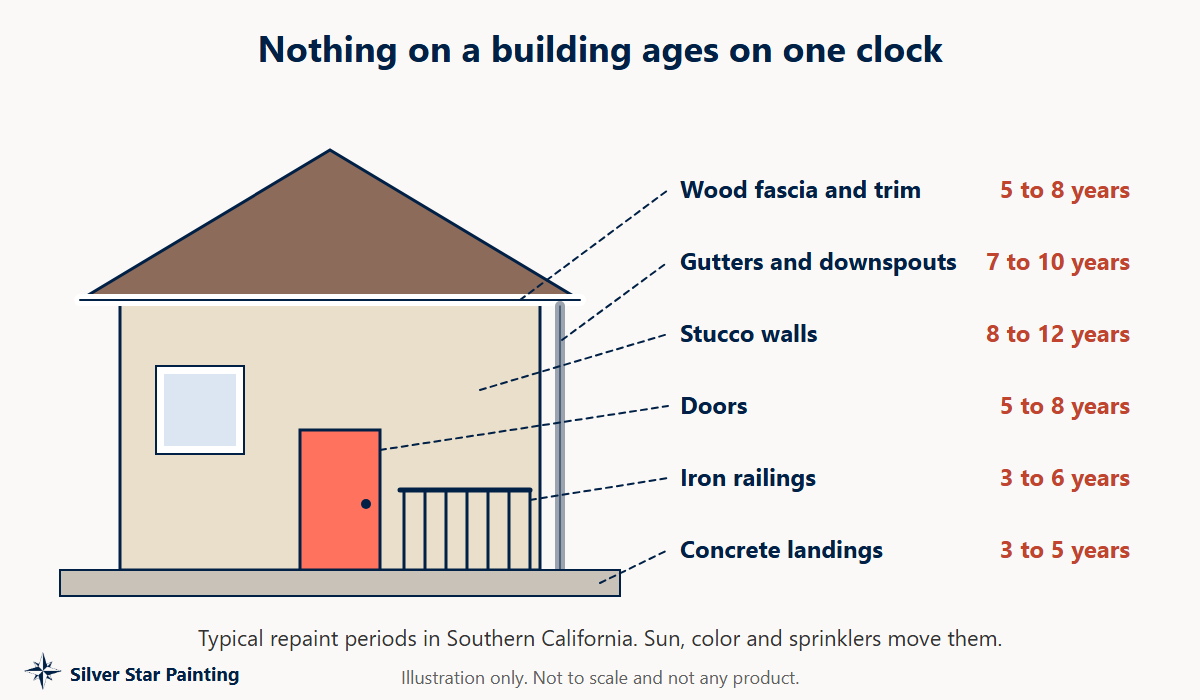 Stucco walls, wood fascia and iron railings fail at very different rates. The most common scheduling mistake we see is painting everything on the walls’ schedule and losing the woodwork in between.
The drawing shows the typical period for the main surfaces. The table below gives every surface and the signs to look for.
Repaint Cycles by Surface
| Surface | Repaint cycle | What tells you the cycle has ended |
|---|---|---|
| Fiber cement siding | 10 to 15 years | Uniform dulling and fade. Failure shows first at butt joints and caulk lines, not in the middle of the board. |
| Stucco walls | 8 to 12 years | Chalk on your palm; color washed out on south and west sides; hairline cracks widening or darkening. |
| Painted masonry and block | 8 to 12 years | White powdery deposits; blistering where moisture is pushing out through the paint. |
| Vinyl siding | 8 to 12 years | Chalk and fade. It must be repainted in a vinyl-safe color (see below). |
| PVC and composite trim | 8 to 12 years | Hairline cracks where the board moves against fasteners and joints; caulk pulling away. |
| Gutters, downspouts and flashing | 7 to 10 years | Chalking, and rust starting at cut ends, seams and fasteners. |
| Wood siding | 6 to 9 years | Paint cracked across the grain; boards cupping; caulk pulled away at corners and windows. |
| Wood fascia and trim | 5 to 8 years | Peeling at end grain and joints; open joints; soft spots near nail heads. Usually the first failure on the building. |
| Doors and garage doors | 5 to 8 years | Loss of gloss and fade on the sun side. South and west doors go first; dark doors go sooner still. |
| Iron railings, gates and stair rails | 3 to 6 years | Any rust at all. Once corrosion gets under the paint it travels there unseen. |
| Concrete decks, landings and stairs | 3 to 5 years | Wear paths in the traffic lanes. This is a traffic coating, not wall paint, and it runs on its own schedule. |
Read the range, not the midpoint. These intervals assume a properly prepared surface and a 100% acrylic exterior coating in a Southern California climate. Unshaded south and west exposure, deep colors, coastal salt air and sprinklers hitting the building put a surface at the short end. Shade, light colors and a coating rich in titanium dioxide put it at the long end. Two identical buildings on the same street can be four years apart.
Four Things You Can Check This Month
- Walk the south and west sides first. They age first, and they set the schedule for the rest of the building.
- Rub a sunny wall with your open palm. Chalk on your hand means the surface of the paint film is worn away.
- Check the edges, not the middles. Fascia ends, rail bases, downspout bottoms and the lower two feet of every wall fail long before the open wall does.
- Turn the sprinklers away from the building. Sprinkler overspray is the most common cause of early paint failure we see, and the cheapest to fix.
What Color Does to the Clock
- Deep colors are the least stable on any paint, and they fade soonest on south and west walls.
- Dark colors run hot. A dark wall absorbs the heat a light wall reflects, which speeds up aging in the paint and movement in what is underneath.
- On vinyl siding it is a hard limit. A dark color can distort the panel itself, so vinyl must be repainted in a vinyl-safe color.
- Placement is the practical rule. Light to mid colors on the large walls, bold colors on doors, shutters and accents, where a refresh costs little.
For communities that repaint in phases over two or three budget years, this is a scheduling matter: the buildings painted in the first year still have to match those painted in the third. Part 3 of this guide explains why colors fade, and part 1 explains what to look for in the paint itself.
What Waiting Costs
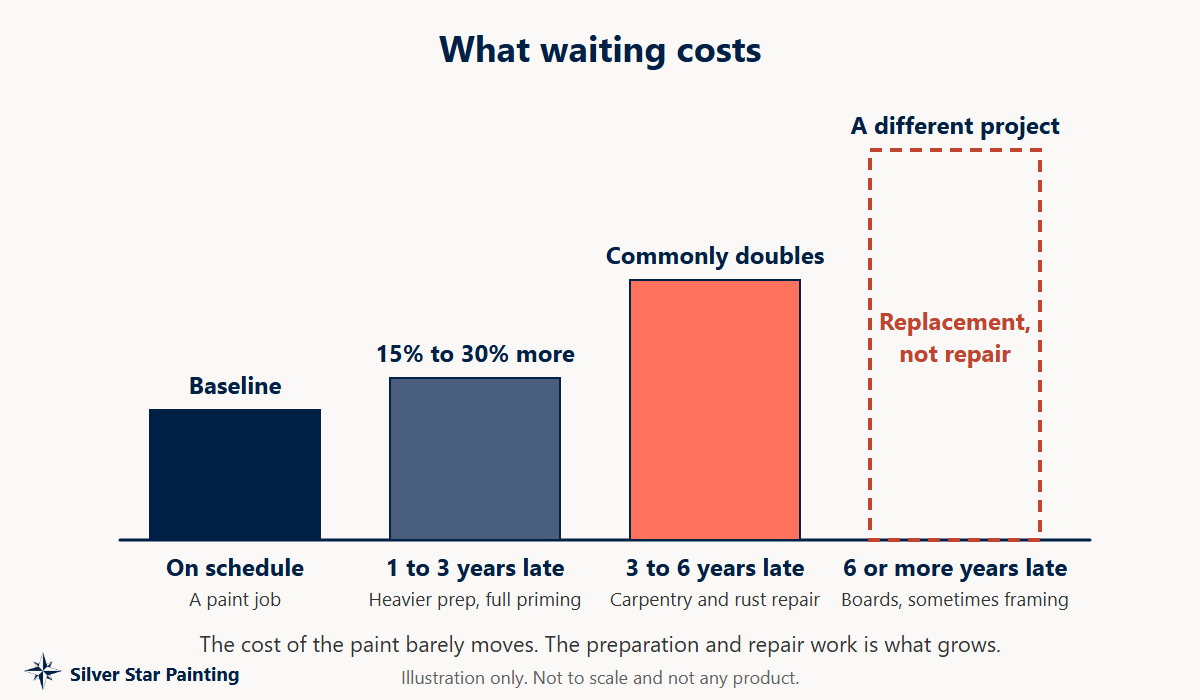 Once the paint is spent, the weather is working on the building itself and the job stops being a paint job. The cost of the paint barely moves. The preparation and repair work is what grows.
| Timing | What the job becomes | Effect on the job |
|---|---|---|
| On schedule | Wash, spot-prime, caulk, two coats. Preparation is a modest share of the work. | Baseline |
| 1 to 3 years late | The paint is chalked and worn. Heavier washing, broad scraping, full priming and more material to cover a thirsty, uneven surface. | Roughly 15% to 30% more |
| 3 to 6 years late | Bare surface in places: stucco cracks open to water, soft ends on fascia and trim, rust under the paint, failed caulk. Carpentry, stucco patching and rust repair enter the job. | Commonly doubles the job |
| 6 or more years late | Replacement rather than repair: fascia and trim boards, the wood behind them, sometimes framing. | A different project, not a paint job |
Waiting also shortens the life of the next coat, because paint over a chalked, worn surface does not grip as well.
The cycles, signs and cost effects on this page are our professional judgment from field experience in Southern California. They are general guidance, not a quote or a guarantee for any particular building.
What an Early Repaint Costs Over Time
A wall that needs repainting in year eight instead of year twelve costs 50% more to keep painted, every year you own the building. For a homeowner, that is three paint jobs in the time two should have covered. For an association, it raises that line of the reserve budget by 50%, permanently. Where a surface lands inside its range is not luck. It is largely decided by what is in the paint and by where each sheen and color is placed.
Related Reading
- Why Regular Maintenance Painting Extends the Life of Your Building
- Seasonal Maintenance Tips: Keeping Your Paint Job Looking Fresh Year-Round
- How to Care for Your Newly Painted Surfaces: Maintenance Tips for Longevity
Not Sure Where Your Building Is in the Cycle?
We will walk it with you. Contact us or call 951-780-4337. See also our exterior painting, power washing and fascia and trim repair services.