
Exterior paint guide, part 1 of 4. See all four parts.
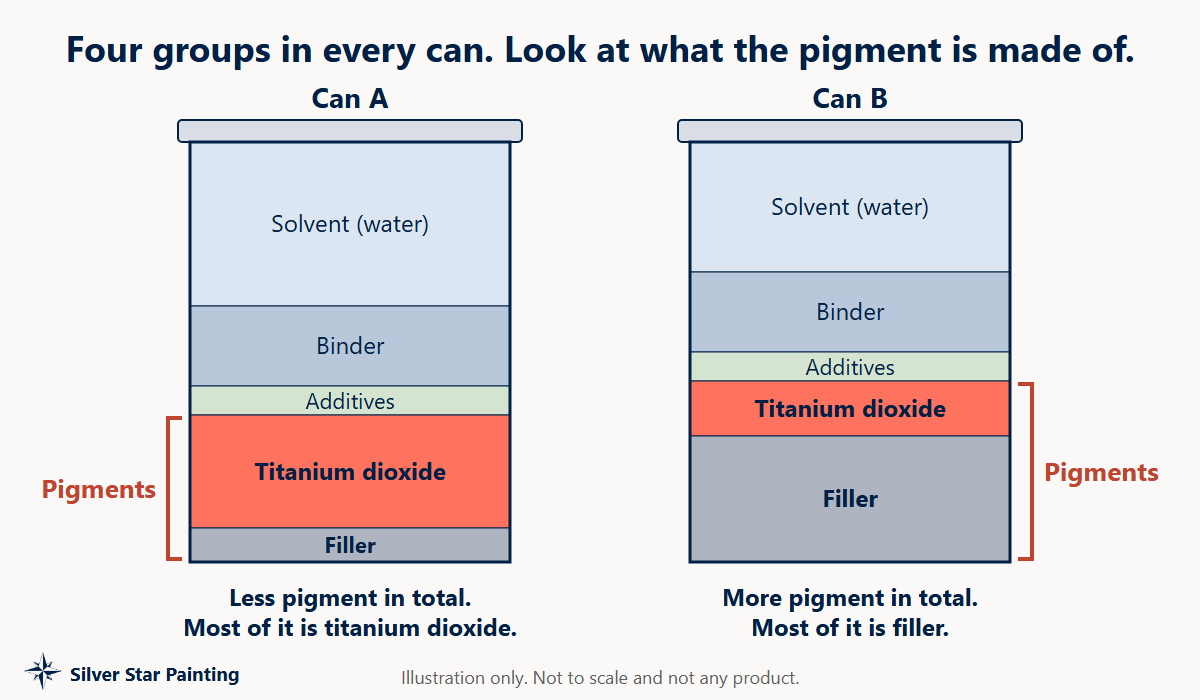 Two cans of paint can look the same on the shelf and behave very differently on a wall. The difference starts with what each can is made of.
Every paint is made of four groups of material: pigments, binder, solvent and additives. The two cans in the drawing hold the same four groups. What differs is how much of each, and what the pigment is made of.
That is the first thing to look at when you compare exterior paints, and manufacturers publish it. If you would rather talk it through, call us at 951-780-4337.
What Stays on the Wall
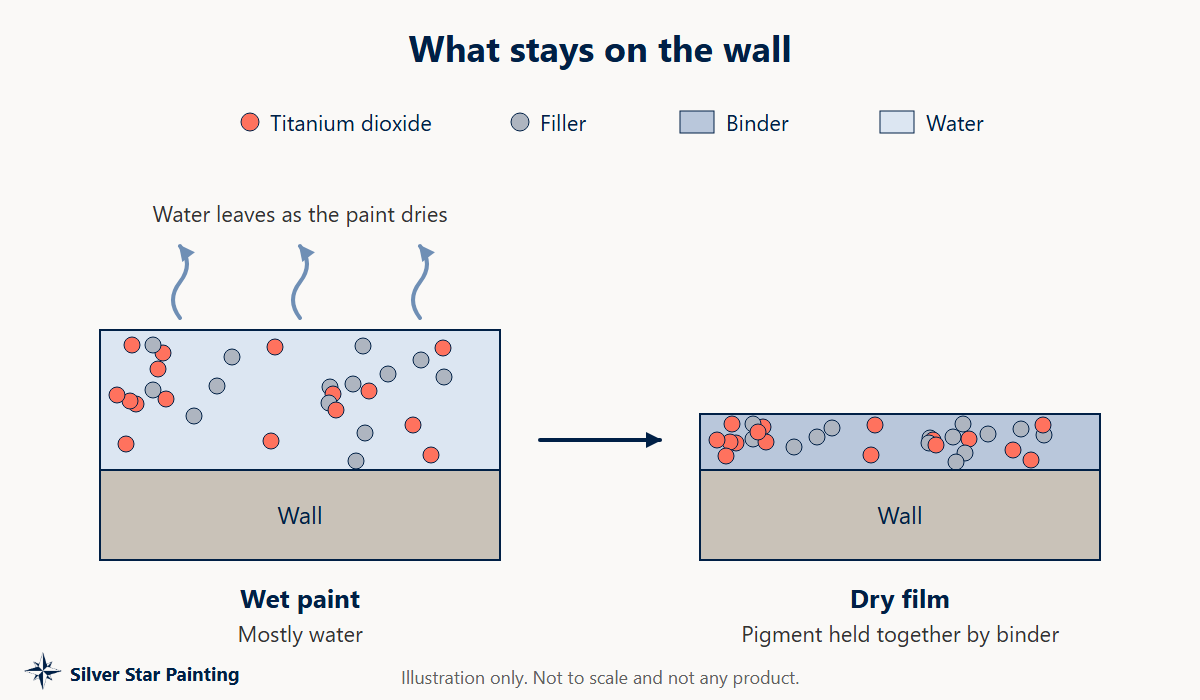 In most house paint the solvent is water, and it leaves as the paint dries. What stays on the wall is pigment held together by binder.
That dry film is thinner than a sheet of paper, and it is all that stands between the weather and the building. Almost everything about how a paint job ages comes down to how much pigment and binder is in that film, and what kind.
The Pigment That Does the Work
 The pigment group holds two kinds of pigment, and they do completely different jobs.
- Titanium dioxide is the working pigment. It hides the old color, holds the tint and absorbs ultraviolet light before it reaches the binder. It is also the most expensive material in the can.
- Extender (clay, silica, limestone) is filler. It adds bulk cheaply and does nothing to stop the sun.
So a paint can be loaded with pigment and still be a poor coating. The useful question is not how much pigment is in the can. It is how much of that pigment is titanium dioxide. In the published data we have reviewed for exterior flat paints, that share runs from about 30% to nearly 80%. The premium lines sat at roughly half or more. The production lines sat near 30% to 37%.
Because titanium dioxide hides so well, a paint rich in it needs less pigment in total. A better paint can therefore have less pigment and lower solids than a cheaper one, which is the opposite of what most people expect.
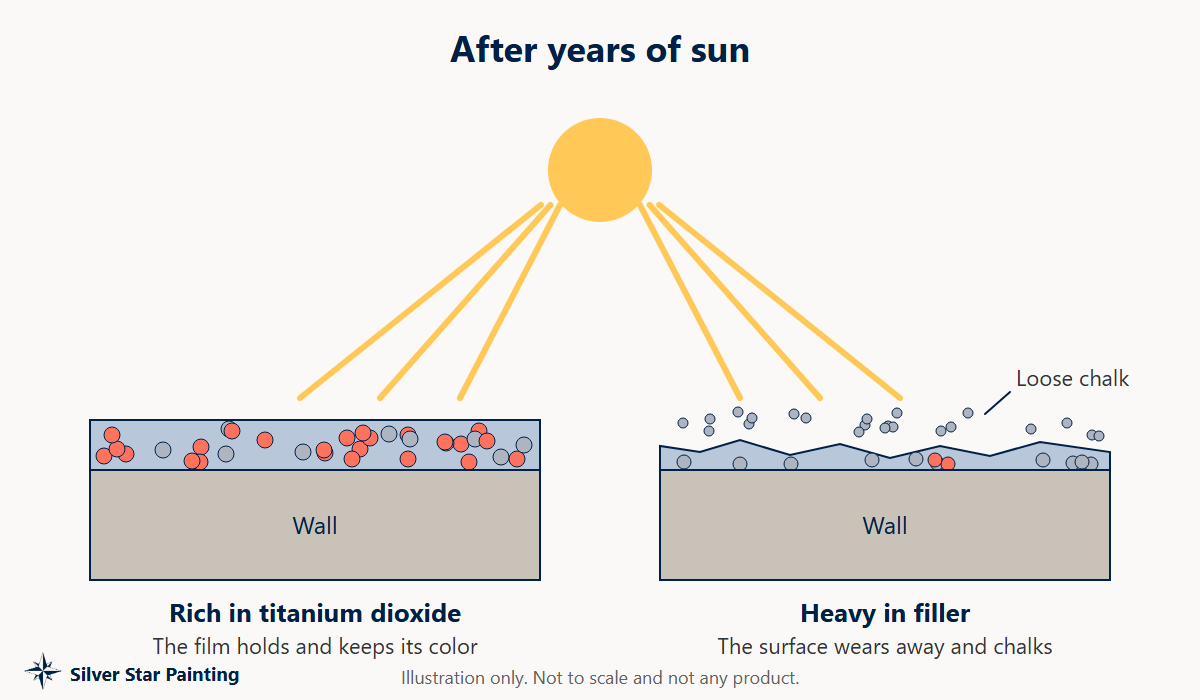
In the sun, a filler-heavy film chalks and fades sooner. Filler carries no tint strength and is the first thing to chalk out from under the color: the binder at the surface wears away and loose filler is left behind.
That gap answers the one question worth asking about a low bid: is the price being reached with premium paint, or with filler?
Try it today. Rub a sunny wall with your open palm. If your hand comes away chalky, the surface of the paint film has worn away and loose filler is what is left.
Why “Solids by Volume” Can Mislead
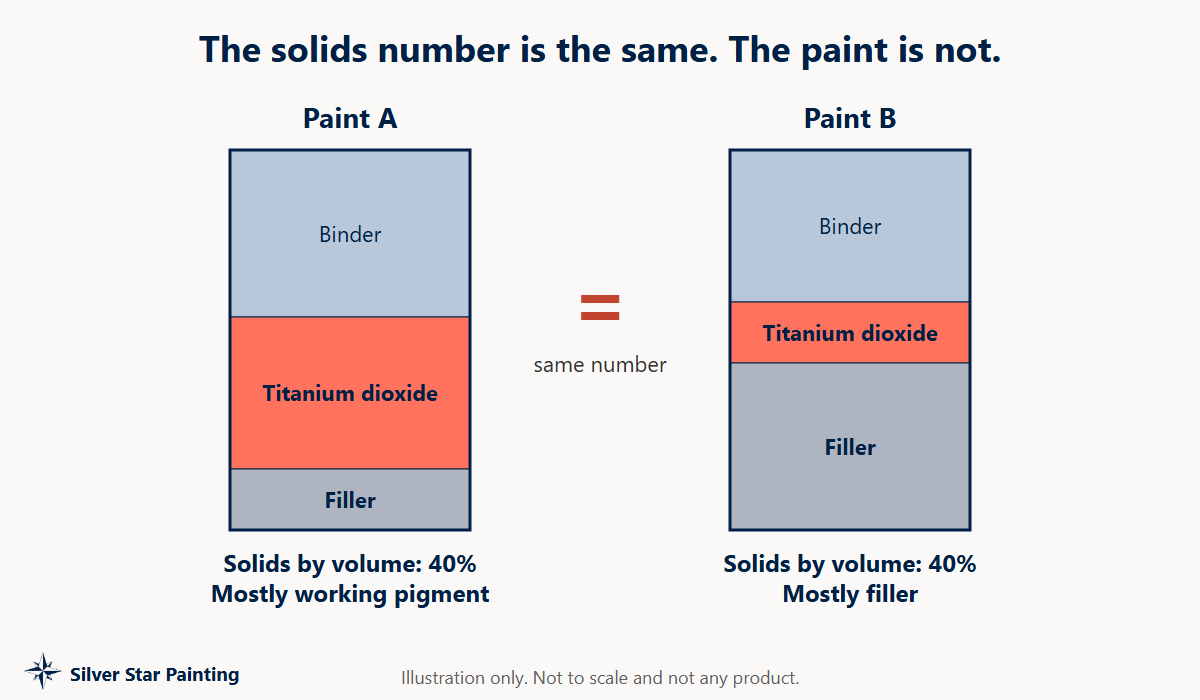 Paint is often sold on solids by volume, the share of the can left on the wall after the water leaves. It sounds like a quality measure. It is not, because it counts cheap filler exactly the same as titanium dioxide.
Titanium dioxide is the densest material in the can, roughly 60% denser than clay or silica. Pound for pound it takes up about 40% less room than the filler it replaces. So every time a paint maker swaps filler for titanium dioxide, the solids figure goes down.
In the exterior flat paints we reviewed, solids by volume ran from 29% to 45%, and the two numbers moved independently. Paints with almost identical solids differed more than twofold in their share of titanium dioxide. Treat solids as a coverage number, not a quality number.
Where to Find the Numbers
You do not have to take anyone’s word for what is in a can.
- The safety data sheet lists titanium dioxide by weight. Some manufacturers print an exact figure. Others print only a wide range, which is still worth reading.
- The product data sheet lists solids by volume and by weight, and often the pigment and filler content.
- Compare flat with flat. Solids and pigment content shift with sheen, so two paints are only comparable in the same sheen.
- Check the revision date. Manufacturers reformulate, and an old sheet may describe an old formula.
A painting contractor should be able to hand you both sheets for the paint in their proposal.
Next: Part 2, binder, additives and ratings.
Questions about the paint for your project? Contact us or call 951-780-4337. We are glad to discuss any of this, whether or not you have a project with us.