
Exterior paint guide, part 2 of 4. See all four parts.
Pigment gives paint its color. The binder is what keeps it on the building.
Part 1 covered the pigment. This part covers the rest of the can, and the one grade a paint can carry that its maker does not write.
The Binder: What “100% Acrylic” Means
 The binder is the resin that fuses into one continuous film and glues the pigment to the wall. Whether a film stays flexible through hot and cold seasons, grips stucco despite its alkalinity or chalks away in the sun is decided mostly by the binder.
Outdoors, 100% acrylic is the floor. Acrylic resins hold their color and stay flexible under ultraviolet light. Most exterior paints meet this bar, so it tells you a paint qualifies for exterior work, not that it is a premium one. A production paint and a premium paint can share the same binder chemistry and differ entirely in what that binder is asked to hold together.
The cheaper binders give that up. Vinyl acrylic is an interior-grade resin. Styrene acrylic blends save money but chalk faster in the sun.
It is the least documented ingredient in the can. The data sheet prints the binder type. Where manufacturers publish the amount of resin, it sits in a narrow band, about 12% to 14% by weight, across every tier and price. What no data sheet prints is the quality of the resin itself.
A well-made binder also helps the pigment: it keeps the titanium dioxide evenly spaced, so every particle hides at full strength. The binder is where published data runs out, which is why this guide leans on the numbers that are published.
The Last Few Percent: Additives and VOC
The additive package is small by weight and large in effect. In Southern California the one working hardest outdoors is the mildewcide: on shaded north walls, anywhere sprinklers wet the stucco and near the coast, mildew and algae, not dirt, are usually what makes a building look tired.
| Additive | What it does | How much it matters here |
|---|---|---|
| Mildewcide | Resists gray-black mildew and algae on the dried film. | The most. Shaded, damp and sprinkler-wet walls depend on it. |
| Coalescent | Lets the resin particles fuse into one continuous film. | A lot. It is what lets paint cure properly on cool, damp mornings. |
| Surfactants, dispersants and defoamers | Wet the pigment, control bubbles, and help the paint flow and level. | They decide how the paint handles on the day. |
| In-can preservative | Keeps wet paint from spoiling in the can. | Storage only. |
| Freeze-thaw glycol | Protects the can from freezing and extends working time. | Little, outside the mountain communities. |
Additives are the least disclosed part of any paint. A safety data sheet lists only ingredients above a reporting threshold, so an additive that is not listed is not necessarily absent. More disclosure does not mean better paint. It only means more of the formula can be checked.
The additives do not answer the sun. Ultraviolet light is the hardest stress Southern California applies, and resisting it is the work of the titanium dioxide and the binder.
VOC is what evaporates while paint dries and cures. Nearly all of it leaves during application and the first days after, and a fully cured film is essentially inert. It is not a measure of durability.
One Rating the Seller Does Not Write
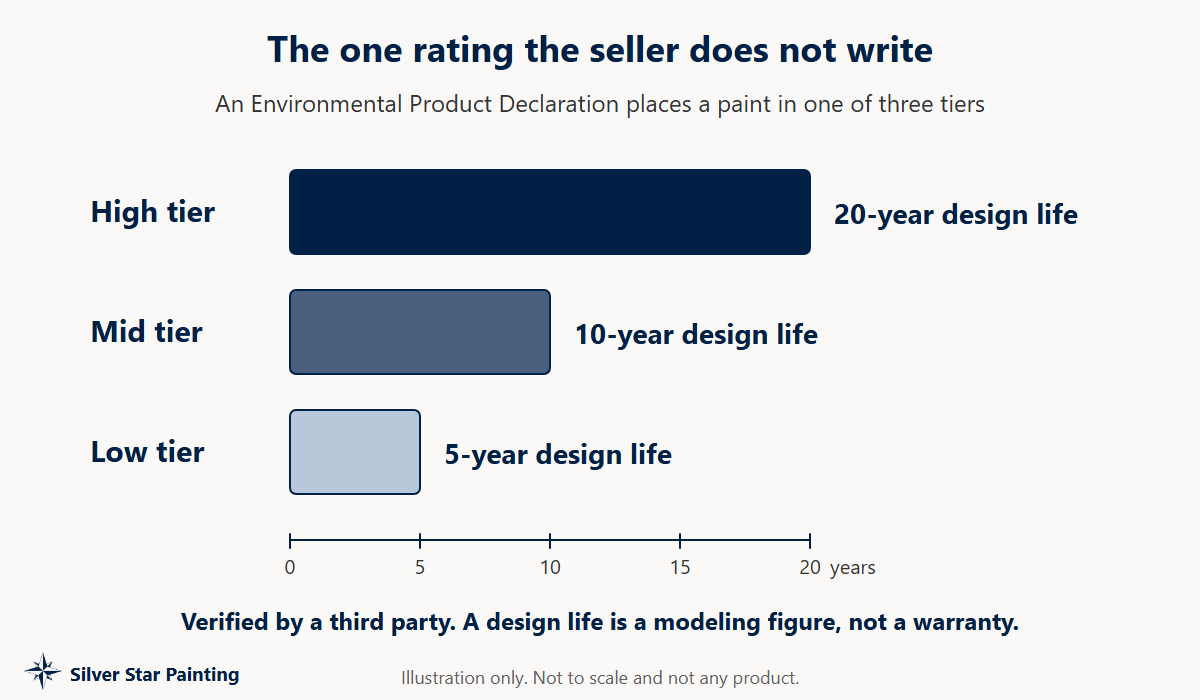 Many paints carry an Environmental Product Declaration (EPD), a document verified by a third party under one shared industry rule. It places the product in a Low, Mid or High quality tier with a design life attached, based on the same standard tests for every product. In the exterior declarations we have reviewed, the high tier carries a 20-year design life, the mid tier 10 years and the low tier 5 years.
Three cautions. A design life is a modeling figure, not a warranty. Not every product has an EPD, which is not proof of poor paint. And declarations expire, so check the date and that it covers the formula sold today. But where one exists, it is the closest thing a paint carries to an independent grade, and anyone can ask to see it.
Price is not a grade. Price is not a proxy for quality in either direction. Judge a paint by what is documented to be in the can, and by the rating where there is one.
Next: Part 3, sheen and color.
Questions about the paint for your project? Contact us or call 951-780-4337. We are glad to discuss any of this, whether or not you have a project with us.